
Equipment / For folding carton packaging manufacturers /Висікальне обладнання / SANWA TRP-1060-SV AXIA
SANWA TRP-1060-SV AXIA
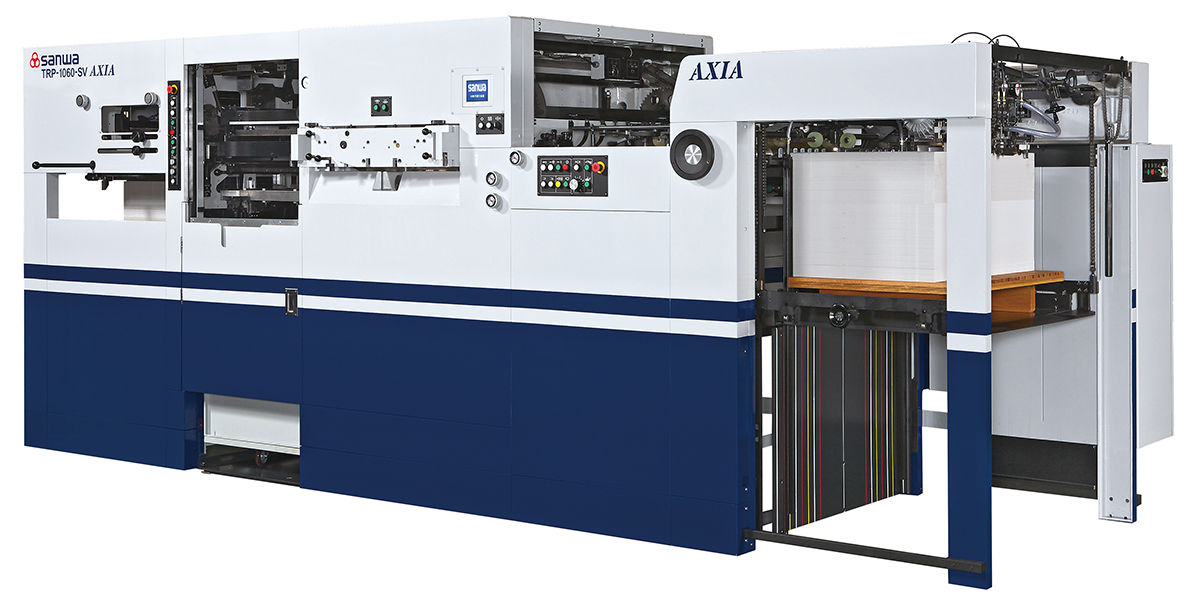
A feature of the SANWA TRP-1060-SV AXIA die cutting machine is improved automation, which allows to reduce the time of preliminary preparation of the equipment for work and reduce the workload of the operator.
Equipped with a three-jaw transmission allows you to use 230 angular degrees of the working cycle of the machine for carrying the sheet. This modification allows you to work with a wide range of materials: thin paper, IML foil, cardboard, corrugated cardboard, plastic and others. The maximum speed of the machine is increased to 8000 sheets/hour.
The suction system along the entire length of the machine — ensures accurate transportation of the sheet, which affects its leveling frequency during all stages of the technological process. In the case of thin materials, this system ensures straightening of the back edge of the sheet, which, due to its weight, has a tendency to curl.
Sheet transportation control — each sheet is monitored at all stages of its passage through the die cutting machine from the feeding device to transportation through optoelectronic sensors. If for any reason raw materials are missing or damaged during transportation, the system will automatically detect such an event, stop the machine, display information about the location of the problem on the control panel, and sound an alarm.
Automatic pressure control (APC) — ensures a constant (set) pressure of the crucible throughout the entire production process, regardless of the change in the expansion coefficient of the material when the temperature changes. A pressure difference of 1 ton actually changes the cutting height by 0.003 mm. This is very important in the context of precision die-cutting and overcutting, so the machine monitors the height of the die placement in the equipment every 10, 50 or 100 sheets and adjusts the setting to the set pressure value.
The crucible balance system is an innovative system that allows you to lift only one side of the crucible, from the side of the sheet grip, thereby causing an even distribution of forces over the entire surface of the tabletop. This idea was proposed by Sanwa engineers in order to reduce the time required to prepare the sheets. In addition, the system eliminates the need to use compensating knives, which allows extending the service life of the die.